8 Best Photo Scanner for Trading Cards (November 2026)
The best best photo scanner for trading cards include the QWUIU Card Scanner Stand for MTG (best overall), the TAROHEART Card Scanner for Trading Cards for dim rooms, and the MildLion Scanstand for Standard Size Trading Cards for travel.
On this page (7 sections)
- How these trading card scanners were compared
- Phone stand scanner vs flatbed for cards
- The best photo scanners for trading cards
- What should you look for in a trading card scanner?
- Are these stands a photo scanner for cards?
- How should you set up a card scanner?
- Which trading card scanner fits your setup?
The best photo scanner for trading cards is the QWUIU Card Scanner Stand for MTG, because its height adjustment lines the phone camera up with the card and its sloped base keeps cards moving into the scan slot. Pick the TAROHEART if your scanning desk sits in a dim corner, or the Canon CanoScan LiDE 300 if you want one device for cards, photos and papers.
A "photo scanner" for cards sounds like a flatbed, but most collectors are better served by a phone stand. These stands hold your phone steady above the card while an app like ManaBox reads it and pulls price data.
The best photo scanner for trading cards is the one that gets a clean, glare-free read and lets you keep moving through the box.
Our picks at a glance
-
1

-
2
-
3
 Best for travel
MildLion Scanstand for Standard Size Trading Cards
8.6/10 our score
See it on Amazon
- 4
 Best for sorting in bulkCheck it
- 5
 Best flatbed all-rounderCheck it
- 6
 Check it
Utllsitm Card Scanner for Trading Cards–MTG
Best for scanning plus hands-free viewing - 7
 Check it
OSTENBIG Card Scanner Pro Max–Card Scanner Stand
Best for glare-prone foil cards - 8
 Best for scanning on the goCheck it
How these trading card scanners were compared
We compared the stands on the features that decide whether a scan succeeds: camera alignment, height adjustment, lighting control and how cards move into the scan slot. A flatbed scanner joined the group as the option for buyers who also archive photos and documents.
Our score weighs specs, features and buyer feedback against what you're shopping for. Phone stands earn high marks for speed and convenience, while the flatbed earns points for resolution and versatility but loses on throughput.
Scores run from 9.7 down to 7.7, and the best overall is the top score.
App support shaped the ranking too. ManaBox is the app these stands name, so a stand that only pairs with ManaBox fits a ManaBox user well but limits anyone committed to a different app.
That's a fit question, not a quality issue.
Phone stand scanner vs flatbed for cards
A phone stand scanner is the faster choice for most collections, and a flatbed is the better archiver. Pick a stand if your goal is cataloging, price checks and sorting.
Pick a flatbed if you want a high-resolution image of each card for insurance or resale listings.
A stand pairs your phone's camera with an app, so recognition and pricing happen in the app as you scan. The QWUIU, TAROHEART, MildLion and other stands here all rely on your phone, which means you already own the sensor.
Setup takes seconds, and folding designs slip into a bag when you leave the house.
A flatbed scans one card at a time and you move each card by hand. The Canon CanoScan LiDE 300 offers 2400 x 2400 dpi optical resolution and 48-bit color depth, so the resulting file holds detail well beyond what a phone camera captures.
That matters for a card you plan to sell or insure.
When a phone stand wins
Choose a stand when speed and volume matter more than the file's resolution. A stand with a sloped base or wide bed, like the QWUIU or EnderToys, keeps cards moving.
For big photo boxes of family pictures rather than cards, our guide to the best home scanner for photos covers the flatbeds built for that job.
When a flatbed wins
Choose a flatbed when you want an archive copy of a card or you also scan photos, receipts and documents. The LiDE 300 handles all of those in one slim unit.
If you're weighing image quality more broadly, our explainer on what a CCD scanner is and whether it's better for photos helps you judge sensor types.
| Product | Best for | Type | Cards | App | Our score |
|---|---|---|---|---|---|
| QWUIU Card Scanner Stand for MTG | overall | Phone stand card scanner | Sleeved and unsleeved | ManaBox | 9.7 |
| TAROHEART Card Scanner for Trading Cards | dim rooms | Phone stand card scanner | 8.9 | ||
| MildLion Scanstand for Standard Size Trading Cards | travel | Phone stand card scanner | ManaBox | 8.6 | |
| EnderToys MTG Card Scanner | sorting in bulk | Phone stand card scanner | 8.4 | ||
| Canon CanoScan LiDE 300 | flatbed all-rounder | Flatbed document and photo scanner | 8.0 | ||
| Utllsitm Card Scanner for Trading Cards–MTG | scanning plus hands-free viewing | Phone stand card scanner | 7.9 | ||
| OSTENBIG Card Scanner Pro Max–Card Scanner Stand | glare-prone foil cards | Phone stand card scanner | ManaBox | 7.8 | |
| Tovims Card Scanner TCG | scanning on the go | Phone stand card scanner | 7.7 |
The best photo scanners for trading cards
The QWUIU is the best pick for most collectors, while each other stand solves a specific scanning setup. The flatbed covers buyers who want cards and photos from one device.
Read each write-up for the job it does best.
QWUIU Card Scanner Stand for MTG: Best overall
- Adjustable height between phone and card
- Handles sleeved and unsleeved cards
- Sloped base for slide-in scanning
- Compatible with ManaBox
A height-adjustable phone stand that gives the camera a steady, parallel view of each card. The sloped base lets cards slide in smoothly for faster sorting and price checks.
Pros
- Height adjusts to your app's needs
- Two setups for sleeved or bare cards
- Sloped base reduces friction
Cons
- App compatibility is limited to ManaBox
QWUIU earns the top score because it solves the problem that breaks most card scans: the camera not sitting parallel to the card. Its height adjustment moves the phone up or down to match your app's framing, which QWUIU says greatly improves the scan success rate.
The stand weighs 1.2 pounds, so it stays put when you nudge the phone into place.
It has two setups. Use the phone stand with the storage box for bare cards, or pair the stand with the mouse pad for sleeved cards.
The sloped base lets cards slide lengthwise into the scanning slot, so you can scan, sort and price check in one flow with less friction. QWUIU's own tip is to scan in natural light and keep the camera parallel to avoid reflected light off the holder.
QWUIU backs it with a one year manufacturer warranty.
One limit to know: QWUIU says the stand is only compatible with ManaBox, and other apps are untested. If ManaBox is your app, this is the steadiest everyday stand here.
The flatbed is the alternative when you also scan photos. For archiving old family pictures alongside cards, see the best scanners for old photos and documents.
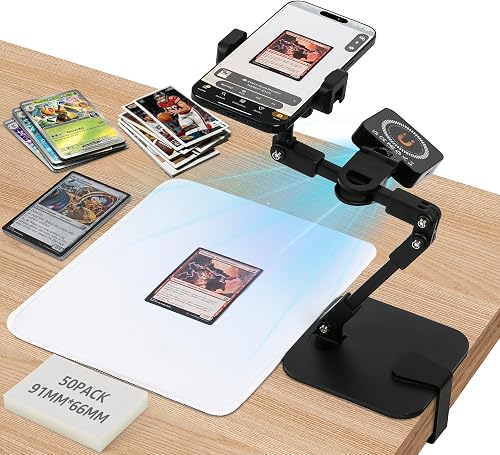
TAROHEART Card Scanner for Trading Cards: Best for dim rooms
- Detachable magnetic LED light
- 12 brightness levels and 3 color temperatures
- Weighted base and C-clip
- Includes 50 card sleeves
A folding phone stand with a rechargeable light that fights glare and shadows. The C-clip keeps the stand steady when the phone leans at a steep angle.
Pros
- Light has 12 brightness levels and 3 color temperatures
- C-clip fits desks up to 1.57 in thick
- Folds flat and includes 50 sleeves
Cons
- Light adds another item to charge
TAROHEART suits a scanning desk in a dim room. Its detachable magnetic LED light is rechargeable and offers 12 brightness levels, 3 color temperatures and 3 flash modes, which gives you a way to soften glare and shadows on holos and foils.
The light also works off the stand for selfies, video calls or overhead shots of crafts and unboxings.
The mount is built from high-carbon steel with a weighted base and a C-clip that grips desks up to 1.57 in thick. That matters when the phone leans far over the card and the stand wants to tip.
It measures 4.33 x 4.33 x 8.53 inches and folds flat when the desk is needed for something else. It weighs 750 grams, so the base stays planted while you work.
Setup needs no tools, and the box includes 50 standard-size card sleeves. The trade-off against the QWUIU is the light itself: it needs charging and is one more piece to keep track of.
For a brighter room and a simpler setup, the QWUIU is the cleaner choice.
MildLion Scanstand for Standard Size Trading Cards: Best for travel
- Built-in LED side lighting
- Lightweight detachable design
- Smooth roller surface
- Adjustable height
A lightweight stand with built-in side lighting that reduces glare on shiny cards. It comes apart for tournaments and game nights, so you can scan away from home.
Pros
- Built-in side lighting
- Detachable and light to carry
- Adjustable height
Cons
- 3D-printed surface has slight texture
MildLion is the stand to take to a tournament or a friend's game night. It's lightweight and detachable, so it packs away, and its built-in side lighting targets low light, uneven illumination and glare.
That makes it useful when the venue lighting isn't under your control. The drawer slides to re-trigger a scan if a card doesn't read the first time.
The smooth roller has a surface designed to reduce friction on cards, and the height adjusts to your preferred angle. MildLion builds it from 3D-printed PLA with extra thickness and density, and notes that the layered printing can leave slight textures that don't affect use.
It weighs 1.2 pounds and comes apart for travel. The brand also offers a card centering grading tool for checking alignment.
ManaBox is the app MildLion supports, and the brand says compatibility with other scanning apps is uncertain. The trade-off is the printed finish: if you want a smooth, manufactured feel in the hand, the carbon steel stands here are the alternative.
If portability is the priority, this is the one to grab on the way out.
EnderToys MTG Card Scanner: Best for sorting in bulk
- Wide scanning surface
- Three detachable sorting bins
- Accepts sleeved and unsleeved cards
- Made in the USA
A scan station with a wide bed and three bins so cards can be scanned and sorted in one motion. It suits buyers working through large collections at a desk.
Pros
- Three bins let you sort as you scan
- Wide scanning bed
- Works with sleeved and unsleeved cards
Cons
- Takes up more desk space than folding stands
EnderToys is built for volume. Its wide scanning bed gives cards room to land flat, and three detachable bins let you scan a card and slide it straight into a category.
That turns a long sorting session into a single motion instead of a stack of scanned cards waiting to be filed. Cards can swipe down, left, right or up depending on how you orient the bin.
The phone mount fits most phones and works with apps like ManaBox. EnderToys 3D prints the station in Las Vegas and includes the rig plus three bins with removable trays.
Pull a full tray, empty it and reinsert to keep scanning without breaking rhythm. The station measures 10 x 4.5 x 5 inches and weighs 1 pound.
The trade-off is desk space: this station stays put rather than folding into a drawer. If you scan a few dozen cards a week, a folding stand like the QWUIU is tidier.
If you're working through boxes, the bins earn their footprint. For foils that keep failing, the brand suggests a simple diffuser like a sheet of paper.
Our roundup of auto-feed photo scanners for big photo boxes covers the paper-scanning side.
Canon CanoScan LiDE 300: Best flatbed all-rounder
- 2400 x 2400 dpi optical resolution
- 48-bit color depth
- Auto Scan Mode
- USB powered
A slim flatbed scanner for photos and documents that also digitizes cards at high resolution. It's the pick when scanning is about archiving as well as price checking.
Pros
- High 2400 dpi resolution
- Handles photos, receipts and documents too
- Fade correction and dust reduction
Cons
- One card at a time
Canon CanoScan LiDE 300 is the flatbed pick for buyers who want cards and photos from one device. It scans at 2400 x 2400 dpi optical resolution with 48-bit color depth, so each card file holds detail a phone camera won't capture.
That's the resolution you want for resale photos or an insurance record. Greyscale is 16-bit internal and 8-bit external.
It's a document scanner first. Auto Scan Mode detects what you're scanning and adjusts settings, and image enhancements include fade correction and dust reduction.
Four EZ buttons handle PDF, copy and cloud uploads, and the unit draws 4.5 watts over USB. The built-in PDF button creates searchable files with OCR.
It's a slim unit at 14.5 x 9.9 x 1.7 inches and weighs 3.6 pounds.
The trade-off against the stands is speed: you place one card at a time. If your collection is thousands of cards, a phone stand will catalog far faster.
Choose the LiDE 300 when the archive copy is the point, or when the same scanner needs to handle family photos and paperwork.
Utllsitm Card Scanner for Trading Cards–MTG: Best for scanning plus hands-free viewing
- Detachable magnetic LED light
- Stepless brightness and 3 color temperatures
- Foldable carbon steel frame
- 360° rotation
A carbon steel stand with a light and a rotating base that doubles as a phone or tablet stand. It folds small enough to keep beside a card box.
Pros
- 360° rotating base
- Folds to 4.56 x 6.7 x 1.77 in
- Includes 50 sleeves and a scanning pad
Cons
- Folding stand still needs a flat surface to sit steady
Utllsitm is a folding carbon steel stand with a rechargeable magnetic LED light. Its stepless brightness and three color temperatures let you dial the light down to reduce glare without switching modes.
The light detaches when you don't need it.
The base rotates a full 360 degrees and doubles as a phone or tablet stand. Folded, it measures 4.56 x 6.7 x 1.77 in, so it slips into a bag or a drawer.
The kit includes 50 standard-size card sleeves and a scanning pad for a consistent background. Setup takes seconds with no tools: unfold, roll out the pad, set the phone.
Utllsitm lists compatibility with a long run of iPhone, Galaxy, Pixel and OnePlus models.
Against the QWUIU, the rotating base is the draw, but the QWUIU's sloped slide-in base is better for scanning one card after another. Pick Utllsitm if you want one stand for scanning and hands-free viewing between sessions.
The light makes it more useful in a dim room than a bare stand. The folding design means it needs a flat, steady surface.
OSTENBIG Card Scanner Pro Max–Card Scanner Stand: Best for glare-prone foil cards
- Rechargeable magnetic fill light
- 3 light modes and 6 brightness levels
- Smooth scanning for sleeved and unsleeved cards
- Works with ManaBox
A plastic stand with a small rechargeable light and several lighting levels. The light is meant to cut glare on holos and foils while you scan and price check.
Pros
- 3 light modes and 6 brightness levels
- Wireless rechargeable light
- Handles sleeved and bare cards
Cons
- Plastic build next to steel stands here
OSTENBIG puts its effort into lighting. The detachable magnetic fill light has a built-in 150mAh rechargeable battery, so there's no cable across your desk.
It offers 3 light modes and 6 brightness levels to cut glare and shadows on foil and holo cards.
The stand scans sleeved and unsleeved cards and works with most smartphones and apps like ManaBox. OSTENBIG says keeping the app updated helps recognition and stability.
The plastic build keeps it light and portable.
The trade-off is material: the carbon steel stands here feel sturdier in daily handling. Choose OSTENBIG when glare is your main scanning problem and you want more lighting control than a bare stand offers.
For a brighter setup with steel construction, the TAROHEART covers both.
Tovims Card Scanner TCG: Best for scanning on the go
- Carbon steel folding stand
- 360° rotating base
- Includes 100 card sleeves and a scanning pad
- Adjustable height
A folding carbon steel stand that packs down to pocket size and comes with 100 sleeves. The rotating base makes it handy for scanning at a shop or a friend's table.
Pros
- 100 sleeves in the box
- Folds to 4.56 x 6.7 x 1.77 in
- 360° rotating base
Cons
- Fewer lighting controls than the light-equipped stands
Tovims is the bundle pick. The folding carbon steel stand includes a scanning pad and 100 standard-size card sleeves, which is more sleeves than most stands here.
The pad gives the app a consistent background for auto-detection. It weighs 1.13 pounds.
The stand has adjustable height and a 360-degree rotating base, and it folds to 4.56 x 6.7 x 1.77 in. That makes it easy to carry to a shop or a trade table.
Tovims says the carbon steel build gives it stability and the rotation helps find a glare-free angle on holos and sleeved cards. The stand fits most iOS and Android phones, and the height dials in camera distance as well as angle.
The trade-off against the light-equipped stands is lighting control: Tovims relies on the room. Pick it if you scan in decent light and want the sleeve bundle for protecting raw cards as you work.
Pick a light-equipped stand like the TAROHEART if glare keeps failing your scans.
What should you look for in a trading card scanner?
Look first at camera alignment, then at lighting control. The stand's job is to hold the phone parallel to the card so the app sees a flat, even image.
Adjustable height is the feature that makes that possible across different apps and phone sizes.
Next, check whether the stand handles sleeved cards. Most here list support for both sleeved and unsleeved cards, but sleeved cards sit higher and the stand must adjust to compensate.
The QWUIU's two setups address this directly.
Camera alignment and height adjustment
A phone camera held by hand tilts and drifts, and the app loses the card. A stand with adjustable height lets you center the camera lens on the card and keep it there.
The QWUIU, MildLion, Utllsitm and Tovims all adjust height. Reposition the phone until the camera lens sits centered over the scanning bed, as EnderToys describes for its station.
The flatbed skips this step entirely, since the LiDE 300 fixes the sensor and glass in place.
Lighting and glare control
Glare is the top cause of failed scans on shiny cards. A detachable light lets you move the source to the side so the reflection misses the lens.
The TAROHEART, Utllsitm and OSTENBIG include lights, and MildLion builds side lighting into the stand. For holographic and foil cards, EnderToys suggests a simple diffuser like a sheet of paper to block excess light.
The QWUIU's answer is natural light and a parallel camera.
App compatibility
ManaBox is the app named across these stands. The QWUIU and MildLion name it as the supported app and say other apps are untested.
Confirm your app before buying, since the stand is only as good as the recognition software behind it. The flatbed avoids the question, because it saves files rather than calling an app.
Card movement and sorting
If you scan in volume, how cards leave the scan slot matters. The QWUIU's sloped base slides cards in smoothly, and the EnderToys station drops scanned cards into three bins.
A folding stand is fine for occasional scans but slower for boxes. The LiDE 300 moves one card at a time by hand, which is slow for a collection but fine for a short list of cards worth archiving.
Are these stands a photo scanner for cards?
Yes, in the practical sense. A stand plus your phone's camera and an app does the scanning job for cards, and it's the faster option for a collection.
A flatbed is the better photo scanner when the file's resolution is the goal.
The flatbed also covers other media. The Canon CanoScan LiDE 300 scans photos, receipts and business cards as well as cards.
If your scanning needs spread across paper and cards, one flatbed can do both jobs.
How should you set up a card scanner?
Set up in even light with the phone parallel to the card. QWUIU recommends scanning in natural light and making sure the phone camera is parallel to the card to avoid reflected light from the card holder.
The same advice applies to any stand.
Then adjust the height until the app frames the card fully. Run a few test scans with a common card and a foil card.
If foils fail, change the light angle or move to a shaded spot. A stand with a scanning pad, like the Utllsitm or Tovims, gives the app a consistent background.
Keep the app updated. OSTENBIG says updates improve recognition and stability.
Work in batches: scan a stack, then sort, so you don't stop for each card. If the card won't read, MildLion's drawer slide re-triggers the scan.
Which trading card scanner fits your setup?
The decision comes down to where you scan and how much. For most collectors at a desk, the QWUIU's height adjustment and sloped base make it the best photo scanner for trading cards.
It handles sleeved and bare cards and keeps a steady, parallel view.
Go with the TAROHEART for a dim room or foil-heavy cards, the EnderToys for bulk sorting with bins, or the Tovims for a travel bundle with 100 sleeves. Choose the Canon CanoScan LiDE 300 when you also scan photos and documents.
Whatever you pick, line the camera up, control glare, and keep the app current, and the scans will stay clean as your collection grows.
Our top 3 picks at a glance
-
1
-
2
-
3
Best for travel
MildLion Scanstand for Standard Size Trading Cards
8.6/10 our score
See it on Amazon
Frequently asked questions
Do I need a flatbed scanner to scan trading cards?
No. A phone stand scanner is faster for price checks and bulk sorting, and most collectors use one with an app like ManaBox.
A flatbed like the Canon CanoScan LiDE 300 is better when you want a high-resolution archive copy of a card.
Can these stands scan sleeved cards?
Most stands here handle both sleeved and unsleeved cards. The QWUIU, TAROHEART, EnderToys, OSTENBIG and Tovims all list support for both.
Sleeved cards sit slightly higher, so adjust the stand height to keep the camera parallel.
Why does lighting matter when scanning cards?
Glare and shadows are the main cause of failed scans. A stand with a built-in light, like the MildLion, Utllsitm or TAROHEART, lets you soften the light on holos and foils.
The QWUIU suggests scanning in natural light with the camera parallel to the card.
Which apps work with phone stand card scanners?
ManaBox is the app named across these stands. The QWUIU and MildLion note ManaBox as the supported app, and other apps aren't tested.
Match your stand to the app you actually use before buying.
How do I keep scans accurate as I work through a big collection?
Keep the camera parallel to the card, adjust the stand height to your app, and control glare. Sort as you scan with a bin station like the EnderToys, or use a stand with a scanning pad to keep the background consistent.